Showing posts with label Ze'ev Kam. Show all posts

Wednesday, February 11, 2026

Army Radio, Smotrich, and Supplies to Hamas

Based on articles in Besheva weekly by Emanuel Shilo, editor of the Besheva weekly and Zev Kam, public news commentator and reporter, edited and translated by Hillel Fendel.


What can we make of the Supreme Court's restraining order against the government's decision to close Galatz (Galei Tzahal, Israel's Army Radio)? This question must be understood on two planes: How should we understand what lies behind it, and what – literally – should we make of it in order to elicit the best results from a troubling situation?

Note that the judges could not deny that the government is authorized to close Galatz \. They therefore "merely" ordered the government to prove that it used its power to do so in a proper and procedurally-correct manner. 

It is our claim, of course, that it is the Supreme Court itself that is is not using its authority entirely properly. Such complaints, however, will not get us very far. At present, we can choose to react in one, or both, of two ways, in order to make some lemon juice out of these lemons. 

1. Army Radio should be "fixed" to make sure it does not broadcast mainly liberal, left-wing, not particularly nationalist views. It should rather have a more balanced line-up of broadcasters. This can be done in several ways. Firstly, the head of the station has a critical role in determining its tone – yet, most unfortunately, even after the Likud won the last election and took over from the Bennett-Lapid government, its first Defense Minister, Yoav Galant, did not take care to appoint a director who would bring a Jewish-national spirit to his position. The current director, Tal Lev-Ram, has served as Army Radio Commander for nearly two years; he can easily be replaced. However, his future, and that of the station altogether, is currently in a twilight zone situation, given that it is set to be closed in less than a month – if the Supreme Court does not make a final ruling to cancel that.

Another problem affecting the Galei Tzahal left-leaning spirit is the type of soldier who serves there. Even after recent significant efforts to diversify the staff's composition, they all still share a very basic trait: they are all non-combat soldiers. They spend their entire Galatz careers in Tel Aviv, and not on the battlefield. This is an important point, as it is well-known that the combat forces lean heavily to the right of the political spectrum; when tallying election results, it is generally accepted that "when the soldiers' votes arrive [they are counted separately]," the nationalist parties will gain a seat or two. Even those Galatz soldiers who come from the periphery absorb the "city spirit" and culture, and end up being influenced "liberally" (pun intended) by the older broadcasters.

Galei Tzahal sorely needs young broadcasters who come with the spirit of the IDF’s core units - the combat units' spirit of patriotic dedication to the country and its security As of now, of course, a soldier cannot be both an Army Radio broadcaster and an infantry man or tank commander. But it should not be too hard to arrange that after two years of service, combat unit soldiers can apply for a Galei Tzahal position.

This would also be a correct step so as not to exclude young Israelis from the opportunity to attend the country’s best media school, which happens to also serve as a springboard to coveted positions in civilian media. Why should they lose this professional advantage just because they served in combat units?

And finally, a great idea to enhance the patriotic spirit of Galatz would be to transfer its offices and studios to the Negev, were very many IDF units are located. This would help the soldiers serving in Galatz absorb the spirit of the field units. A station that broadcasts from the area of the Ir HaBahadim (a large, new, training camp complex serving thousands of soldiers south of Be'er Sheva) will be less Tel-Avivish, and much more IDF-like.

2. Until these changes are made, Army Radio's influence should be cut down. For all intents and purposes, it currently enjoys, together with only one other station (Reshet Bet), a monopoly on the public national radio airwaves. Just as television in Israel was opened to private commercial stations back in 1993, the same should be allowed for Israeli radio – not only regionally, as is the case now, but nationwide. And just as the commercial TV stations have proven to be a success, in terms of professionalism and political diversity (Channel 14 is known as a nationalist station and enjoys high ratings), so too can be expected if radio is opened up to national commercial concerns.

And so, even if the judges end up blocking Galei Tzahal's closure, the government is hereby advised to open national radio to competition, and thus supply the public with additional listening options. This will also lower Army Radio's ratings and reduce the damage it causes to the national morale. 

3. From here to the economy: The international financial services company Moody's has upgraded the State of Israel’s sovereign credit to Baa1, with a “stable” outlook instead of "negative." This past November, S&P made a similar decision. The positive state of the Israeli economy can no longer be denied, featuring its low inflation, low unemployment, very strong shekel, soaring stock market, and lower-than-expected government deficit. And all this after three difficult years that began with the cold civil war regarding the judicial reform and continued with two years of difficult and expensive combat in Gaza.

Finance Minister Betzalel Smotrich came under much criticism for economic problems arising during his tenure, which were the inevitable result of the events of those three years. This criticism was clearly biased, stemming mostly from opposition to his positions on other issues, such as the importance of settling the Land of Israel. Now, when it can no longer be denied that the economy is doing much better than was feared, it would be nice if those who attacked him would give him some credit for its successes. Commentator Dr. Guy Bechor stands out for having spoken just recently of Smotrich as "one of the better finance ministers Israel has ever had."

4. An important note regarding Gaza and continuing American pressure: Political analyst Zev Kam notes that Hamas continues to rehabilitate and strengthen itself – and not without Israel help. The members of the Knesset Foreign Affairs and Defense Committee heard an intelligence report informing them that while Israel allows between 600 and 800 truckloads of "humanitarian aid" to enter Gaza each day – the fact is that there is no need for more than 75 to 150 such truckloads.

This means that Israel is strengthening Hamas, which profits directly from the extra supplies, to the tune of between four to ten times the amount of aid that is required. Why does Israel allow this, given Hamas' ongoing threats to work to repeat the Oct. 7th massacre? The answer given to the committee members: "This is a diplomatic [governmental] decision stemming from international pressures."

Wednesday, November 12, 2025

What to Do About a Problem Named Gaza?

by Zev Kam, public news commentator and reporter, translated by Hillel Fendel.


Here's a peek inside the recent Israeli Government cabinet meeting where the ministers discussed their options regarding Gaza. One thing is clear: Much is still unclear, even to the ministers.

There are those who believe in the model called “New Gaza.” That is to say, the broken area known as the Gaza Strip should be cleared of its ruins and rebuilt anew as a modern, flourishing, blooming district. The U.S. Administration is fully in, raising massive funding from the Gulf states and forming a coalition to supervise the reconstruction and help police the area. Everything is carefully outlined, down to the smallest details – but the Americans seem to have forgotten one very small point: the people involved. This particular component of the plan is filled with hatred of Jews and of the West in general. It's nice to plan buildings and sidewalks and the like, but if the people who are to populate these are Gazans, it's a lost cause.

Still and all, there was one Cabinet minister at the recent Israeli Government meeting on this topic who seems to have been infected with the Americans' enthusiasm for the project: American-born and raised Ron Dermer, Israel's Minister of Strategic Affairs. This is a position from which he has just resigned as these lines are being written, for family reasons. He is a close confidante of Prime Minister Binyamin Netanyahu and plays a major role in Israel–U.S. relations and diplomatic policy. While the other ministers at the meeting raised important question marks and deep fears regarding what the Americans are planning for us in Gaza, Minister Dermer seems to think it's the greatest thing since apple pie.

Hamas Stalling All the Way

Let's begin with one party that certainly has no intention of cooperating with the plan to rebuild Gaza Hamas-free, and that is of course, Hamas. Hostages Administration chief Gal Hirsch said that every one of the remaining hostage corpses – currently four, down from 13 when Hirsch was speaking – is accessible to Hamas, "and they can return them, if they want." He showed how Hamas is able to reach, within a very short time, each and every single remaining corpse.

For instance, four of the corpses that were recently released were all held in the same place, and yet still, Hamas returned them in drips and drabs: first two, then one, then another one. This means, IDF Deputy Chief of Staff Gen. Tamir Yed'i explained, "Hamas intentionally wasted time in returning the corpses." This was motivated of course, by the desire to torment Israeli families and the entire public, but not exclusively. Hamas also has an interest in dragging out this interim period so that it can liquidate more of its enemies and fortify its grasp on the 48% of Gaza it still controls.  

Essentially, Hamas' objective is to take the exact opposite approach from the Trump Plan. Clear and detailed proofs of this have been shared with the Americans. Israel, for its part, is "punishing" Hamas by holding up three things that Hamas wants: the opening of the Rafah Crossing, the entry of dual-use items into Gaza [items that can be used both for civilian and military purposes] and the entry of fuel for a power station. In truth, of course, these are rather minimalist sanctions.

And this returns us to Minister Dermer, who said, "If in fact New Gaza is built, that means the end of the Hamas regime, to be replaced by something entirely different, without the Palestinian Authority. Different people will run it."

Who are these "different people"? Dermer did not answer. He did say, however, that "if Hamas does not disarm, or if the foreign forces do not disarm Hamas, we'll do it ourselves – and the Americans know this. We are taking Gaza from the PA and from Hamas, and building up something else, for the residents of Gaza." The other ministers were not encouraged by these remarks, and in fact had strong questions/objections.

For instance, one question was, "Where exactly will the multi-national force operate? In the Israeli-controlled area of Gaza, to the east of the new Yellow Line, or on the Hamas side?" Most astonishingly, no clear answer to this basic question was provided, even though several attempts were made. Dermer himself said something that caused a storm: 

"It could be that the rehabilitation part will occur on our side. That is, if something nice is built on the Hamas side, little by little we'll move the Gazans who are not involved in terrorism to live in New Gaza, on the Israeli side."

What?! The ministers could not digest the possibility that not only would the Gazans remain in Gaza, but that those who are "sweet and cultured" would actually live practically adjacent to Kerem Shalom, Nir Oz, and Sderot! At least now there is a buffer zone separating them, thanks to the IDF’s presence in half of Gaza. "It absolutely can't be," complained Minister Ze'ev Elkin, "that we will finish this entire event with Hamas in the west and these new [Arab] forces in the east, practically atop our communities."

Netanyahu Insists: Hamas Will Disarm

At this point, Netanyahu intervened and said that from his standpoint, the international forces must replace Hamas in all areas, and that it all must happen on the Hamas side of the Yellow Line. "And in any event," he continued, "Turks, Egyptians, and Qataris will not be there." He continued to try to allay fears by saying that the rehabilitation of Gaza is dependent upon Hamas disarming, which will happen only on their side. Ministers Gamliel and Elkin were not comforted, and Minister Smotrich said, "We have missed a great opportunity. We could have ruled in Gaza the way we rule in Judea and Samaria – after all, in the end, it's our land."

Ambassador Votes Confidence in Bibi

One of the participants was someone who does not usually attend Cabinet meetings: Israel's Ambassador to the U.S., Yechiel Leiter, a Torah scholar who lost a son during this war in Gaza. He said: "We don't realize what an amazing miracle happened here! When I asked the Prime Minister to ensure that Hamas not remain in Gaza, I never imagined that this would be part of a genuine American plan that the whole world supports! But now we have to know how to actualize this. We have to let the Prime Minister run this vis-à-vis the Americans, the way I saw him up close running the story with Iran. I trust that he will do it successfully."

Another question is who will make up the "technocratic" government that will run Gaza. Some ministers said that they well know that many of the candidates are recommended by Hamas or, equally bad, are PA representatives. Elkin lamented to Dermer, "This will be a Hamas-PA unity government, which is against the Trump Plan." Dermer said, "The Americans agree with you, and they won't let it happen." Smotrich chimed in, "If it's neither Hamas nor the PA, then it's an 'empty set,' which doesn't exist in this context." 

Minister Orit Strook, a resident of Hebron, told Netanyahu that the problem began when he agreed to internationalize Gaza. She reminded him that after the Wye Agreement by which Israel withdrew from most of that city, he promised to send in tanks if the home of Strook or her neighbors would be fired upon. "Our house was in fact targeted," Strook said, "and my son was wounded, as you know. But you couldn't send in tanks – because you were no longer in office."

The moral of the story, Strook continued, is that whatever the Prime Minister does, he must take into account that the moment of truth might happen under someone else's watch. "The minimum you have to do is to guarantee that we have total security control in Gaza, just like in Judea and Samaria, so that the IDF can enter wherever and whenever it has to."

Reliving the Disengagement? 

Coming to Bibi's defense at this juncture was Minister Dudi Amsalem, who said, "Israel does not want to rule over two million Gazans, and that's why we prefer to internationalize the area." Let's leave aside the fact that this number is a total exaggeration, and that Amsalem is falling into the false narrative trap that the Arab world likes to tell about Gaza. More important is that Amsalem's excuse is of the type that Ariel Sharon and his supporters used over 20 years ago when they executed the Disengagement and threw out the nearly 9,000 Jews then living in Gaza – and we know where that got us.

Friday, August 8, 2025

Game-Changer on the Temple Mount

by Ze'ev Kam, Besheva newspaper, translated by Hillel Fendel.


With the advent of Public Security Minister Itamar Ben-Gvir on the scene, the status of Jews coming to pray on the site of the Holy Temple in Jerusalem has improved unrecognizably.

In 1992, 16-year-old Itamar Ben-Gvir joined up with the original Temple Mount activist Gershon Solomon and his Temple Mount Loyalists movement. In those days, violent riots were a common sight on the Mount, in response to the Jewish visits arranged by Solomon's Loyalists. At one point, Solomon declared his intention to ceremoniously place a foundation stone on the Mount for the construction of the Third Temple. This prompted the police to forbid him to visit the Mount, and in fact greatly restrict Jewish presence there. The police forbade Jews even from "murmuring" there, for fear that they were actually, Heaven forbid, praying.

The situation became so absurd that even drinking water was banned, because the police suspected that the purpose would not simply be to quench thirst, but to recite a blessing over the water at Judaism's holiest spot on earth. The Spanish Inquisition couldn't have done it more efficiently.

During one of the visits, young Itamar asked the police why they were treating the Jewish pilgrims to the Mount so badly. The policeman said, "That's the decision of the Police Minister" – and then added, "When you become the Minister of Police, you can decide whatever you want."

This disparaging sentence was seared into the boy's head – and this week, 30-plus years later, he ascended to the Temple Mount, this time as Public Security Minister [the equivalent of the Police Minister then], and conducted a full-fledged prayer service, including singing of Kinot, on the fast of Tisha B'Av.

Let's go back two and a half years. In the midst of coalition-formation negotiations between the Likud and Ben-Gvir's Jewish Strength party, with the main points of the agreement essentially agreed upon, Netanyahu and Ben-Gvir sat down for a cup of coffee. The talks were taking place in the Leonardo Hotel, with a fantastic view of the Temple Mount plaza. Ben-Gvir pointed to it and stated, "Without understandings regarding the Mount, we can't come to an agreement." Netanyahu said, "What do you want? To build the Third Temple?"

Ignoring the cynicism, Ben-Gvir responded, "That's not a bad idea at all, but for now we can start with some smaller things."

Following this exchange, talks began between the parties regarding exactly that issue. Ben-Gvir made it clear that he would not accept a continuation of the manner in which Netanyahu had agreed to run the Temple Mount up to that point. Precisely then, Ayalah – Mrs. Ben-Gvir – walked in. After the sudden death of her younger sister some years before, Ayalah had begun to visit the Mount frequently to find solace – and took part in meetings with the police to find ways to make it easier for Jews to visit.

Her presence at this coalition meeting apparently did something to Netanyahu, who heard from her about the discriminatory and unfair treatment the Jewish visitors faced. Netanyahu also heard from the Ben-Gvir couple the words of Uri Tzvi Greenberg, a nationalist poet of pre-State days who was a close friend of Netanyahu's father, regarding the centrality of the Temple Mount. It became clear to all that something had touched the Prime Minister regarding the difficulties facing Jews who seek to visit their holiest site.

It's not that all of a sudden Netanyahu ordered an about-face in Jewish visits. Rather, he stopped fighting the changes that were sought, and he seemed to accept that things would no longer be the same on the Mount. Ben-Gvir, too, who generally fights for what he wants in a "here and now!" manner, understood that the changes would have to come slowly. And in fact, the first changes came exactly that way: Instead of 4.5 hours of Jewish visiting hours each day, including one hour in the afternoon, small additions were made here and there – and the situation today is that the Temple Mount is open for Jews for 4.5 hours in the morning, and 1.5 hours in the afternoon.

Taking Charge

But of course, much more important than visiting hours is the question, "Who's in charge?" If in the past it was well-known that the police more or less disappeared during the Muslim prayers, and especially during the Friday mass prayers, today the story is quite different. Israeli policemen now actively arrest Temple Mount rioters and instigators – most notably, preachers who incite against Israel – even during the prayers. Add to this the fact that public Jewish prayer is now allowed on the Mount, complete with prostrations and singing, and it appears that a veritable revolution has taken place.

One thing remained unclear, however. Why did PM Netanyahu insist, after every well-reported visit by Minister Ben-Gvir to the Mount, on releasing a statement claiming that the status quo there remains stable and will continue as such in the future?

No Phones During the Prayers

The answer lies in a meeting of several people in the Knesset last year shortly before Tisha B'Av, on the topic of the Temple Mount. Ben-Gvir stated there that from his standpoint, as a member of the government, Jewish prayer is officially permitted. And in fact, that very year on Tisha B'Av, Jewish prayer was no longer held in a clandestine fashion, but quite openly. And thus, when Netanyahu says that the status quo is being maintained and will be maintained, he is quite correct, in that the nature of the status quo is determined by the government echelons – in this case, the Public Security Minister.

Sometimes, the status quo is determined by mistake or non-action. One day a few years ago, the Waqf decided unilaterally to open another mosque on the Mount, within the Mercy Gate compound on the eastern side. Israel found itself unable or unwilling to fight it. Interesting, none of those who today decry and protest the "changes" in the status quo, protested the Waqf's trampling then of the status quo…

Shabak Meddling

Let us return to Tisha B'Av of last year. The Shabak (General Security Service) was not happy with the Jewish prayers, and demanded that the Police Commissioner remove the public Jewish worshipers and stop them from "violating the rules." The commisioner responded, "Sorry, I have a Prime Minister and Public Security Minister who tell me what to do, and you can turn to them if you'd like." The Shabak contacted Netanyahu, who called Ben-Gvir, who at first did not answer. When he finally did answer, the Prime Minister asked him why he hadn't answered at first. "I was precisely in the middle of praying on the Temple Mount," he said.

After a few seconds of pregnant silence, Netanyahu said, "It's precisely about that that I wished to speak to you." After he explained, Ben-Gvir answered, "I told you at the very beginning that I will not allow apartheid against Jews at the holiest Jewish site in the world."

This past Tisha B'Av, a year later, Jewish singing could be heard vibrantly on the Mount. Just as Netanyahu's statement announced, the status quo there is being precisely maintained, exactly according to the outline set by the relevant Cabinet minister. And if there are some bleeding-hearts who want to turn up their noses at it, then, as the late Prime Minister Menachem Begin once said about those who reacted similarly to certain proactive Israeli moves, "let them have crooked noses."

Wednesday, June 4, 2025

From Paris Shall Come Forth Sovereignty [in Yesha]

by Zev Kam, Kan Israel correspondent and Besheva columnist, translated by Hillel Fendel.


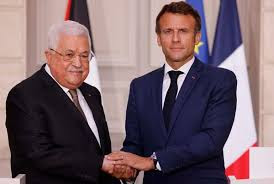
It could very well be that President Macron's obsession with a Palestinian state will be the trigger that could bring about Israeli sovereignty over Judea and Samaria.

The countries of Europe granted the State of Israel very few days of grace after the slaughter of Simchat Torah (Oct. 7th). It was only during the first days, when Israel was really on its knees, battered and broken, that the Europeans were willing to support us. Within a short time, however, with Israel in the midst of bitter, existential battles in Gaza, the same old vile calls began to be heard – about the disproportionate nature of our response, about our obligation to enable our mortal enemies to receive humanitarian aid (including, of course, much non-humanitarian aid], and about the need to end the war, no matter what the future cost to us might be.

Countries such as Spain, France, England and others began speaking of Israel in terms until then reserved only for their biggest enemy: Russia. They declared that they would impose sanctions, they threatened to unilaterally recognize a state of Palestine, and of course they accused us of genocide and other war crimes. If in Israel there remained a small minority of people whose opinions about peace with the Arabs did not change after Oct. 7th, in many parts of Europe the reaction to Oct. 7th was even worse: Many began to take a strong stance against Israel! They managed to find a way to blame Israel even for being slaughtered and for everything that followed, with no need for evidence or proof and relying only on the barefaced lies of Hamas.

Yet from bitter adversity often comes blessing. The hatred directed at us has actually led to the reopening of a very blessed and surprising development: the matter of Israeli sovereignty in Judea and Samaria.

First of all, the arrival of U.S. Ambassador to Israel Mike Huckabee has signaled a welcome change in the US approach to Yesha. If in the past, the State Department forbade its envoys to Israel from setting foot in Yesha, and if even former Ambassador David Friedman had to pay condolence calls to Yesha families not in his official capacity but only as a private person – Huckabee is taking precisely the opposite approach. One of his official welcoming ceremonies took place in none other than ancient Shilo in the Binyamin region of Samaria – one of the sites that express most strongly the Biblical ties between the Jewish People and the Land of Israel.

One would have thought, then, that Israel would have been by now well on its way, with American support, to declaring its sovereignty in Yesha, as originally and long promoted by Women in Green. Yet, in fact, the matter of sovereignty has not even come close to being top priority, neither in Israeli thinking nor in American, because of the many other issues the two countries must deal with together.

And yet now, this might be changing – not because of an Israeli or American decision, but because of something going on now in France, and particularly with its president, Emmanuel Macron. When he's not getting pushed around by his former teacher and current wife, he seems to be busy with shoving of his own: pushing Israel into a corner and forming a Palestinian state.

The PA State June Conference

Macron and his Saudi friends have announced a "June Conference" to be held at the United Nations this month, "aimed at advancing global efforts towards achieving a two-state solution to the Israel-Palestine conflict." Last week Macron brought Great Britain and Canada on board with a joint declaration regarding not only Judea and Samaria, but also Gaza – an artificial and forced conglomeration that, if it succeeds, will only shove peace further away.

So far, so bad – but in truth, it might actually be the harbinger of something very good. Macron has unintentionally restored to the table the historic settlement enterprise of Judea and Samaria, whose status has been limping along for decades. Now, however, due to Macron's efforts, it might actually come under full Israeli sovereignty – finally! How so?

It's very simple: When a foreign country seeks to grant legitimacy to the sworn enemy of another country (Israel, in this case), and grant it a state in Israel's heartland while Israel is still licking its wounds of the Oct. 7th massacre, Israel can simply not stand passively by. It will have to respond with a bold move of its own – and that will likely be a Knesset vote to support sovereignty in Judea and Samaria. This is not just a guess; top Israeli figures, whose names are mentioned below, have made it clear that this is what will happen.

The Yesha Council of Jewish Communities in Judea and Samaria is taking the lead in ensuring that the Israeli response will be, as a first step, a ceremonial Knesset resolution to this effect.

In truth, it shouldn't be much of a big pill for the Israeli public to swallow. One of the many things that all Israelis share is the fear that an Arab mob might invade our communities, just as happened on Simchat Torah. This is the great concern that, for years, drove the residents of the north to demand aggressive action against Lebanon, and it is now what motivates the residents of the Coastal Plain – Raanana, Kfar Saba, and points north, west and south – to push for the strong IDF offensives against the terrorists of Jenin and their neighbors. Israeli sovereignty in Yesha can answer these anxieties in several ways: Yesha will no longer be considered the forgotten backyard of the State of Israel; passivity will be replaced by initiative, especially military; and the country's entire approach will take on a proactive nature rather than defensive.

The Lessons of Judicial Reform

Having learned the lessons of the pre-Oct. 7th attempts to change Israel's judicial system, the Yesha Council is working overtime to make sure that the drive for sovereignty will not take on the same confrontational nature. How can this be done? By returning to the model of "opposition to a Palestinian state." During the course of the current war, the Knesset has already passed declarative resolutions against this dangerous entity – and the most important part of this development was that the votes were bipartisan, coordinated between leading MKs of both the coalition and the opposition.

And this is also why Yesha Council has reached out to enlist MKs Simcha Rotman (of the coalition's Religious Zionism party) and Oded Forer (of the opposition Yisrael Beiteinu party) in a joint effort to sponsor the Knesset resolution for sovereignty. A bipartisan initiative of this type will not lend itself to being brushed aside easily by the anti-Netanyahu forces – but just as importantly, it will help Israel in the international arena. This is because our good friend the United States cannot be more Zionist than Israel! Behind closed doors, the Americans are saying that Israel must first come out strongly against a Palestinian state, and only then can they themselves support that stance! As such, Macron's anti-Israel obsession may turn out to be the first step of the salvation we have been awaiting.

It must be noted that the matter of sovereignty has never been a top priority of Prime Minister Netanyahu. But even he now understands that he cannot ignore a European resolution favoring a Palestinian state. His trusted political ally, Strategic Affairs Minister Ron Dermer, even recently told Administration officials that Israel's immediate response to the Saudi-French initiative will be the application of Israeli sovereignty in Judea and Samaria. Foreign Minister Gideon Saar, too, gave a similar message to the British and French.

Why is the Macron initiative so dangerous? Because it is liable to lead to international sanctions against Israel, such as more wide-ranging embargos on Yesha goods, perhaps a boycott of Israel in international cultural events, and of course a platform for recognition by more and more countries of a dangerous, fictional Palestinian state.

Mr. President Macron, it could very well be that we will end up thanking you for your hatred of us and the welcome decisions it stimulated us to make. 

Friday, May 9, 2025

Greener on the Other Side? Not So Sure

by Zev Kam, tour guide, journalist, and frequent commentator on Kan Public Israel Radio, translated by Hillel Fendel.


A Light, Encouraging View From the Lebanese Front

In the summer of 2021, less than four years ago, the soldiers of Battalion 221 of the IDF's Carmeli Brigade were on reserves duty, with the routine mission of holding a line on the Lebanese border. The troops were stationed at the time on the western side of the border line – precisely as they are now, during these five months since the ceasefire with Hizbullah/Lebanon. Aside from the location, there is nothing else of the two periods and the two stints of duty that are comparable.

Then, four years ago, what frustrated the soldiers no end, and what was their lot throughout their tour of service, was the fact that they could see Hizbullah terrorists just beyond the fence – and there was nothing they could do. The terrorists would stand with cameras and photograph the soldiers' faces, curse them, hold up middle fingers – and the soldiers' hands were tied; they could not respond.

The terrorists even built structures right on the border, from which they could peer directly into Israel – and our soldiers, again, were helpless. It was some kind of "decree of destiny" imposed by an army and its leaders that had simply become accustomed to having the enemy mock them, learn their actions and schedules, and even erect a tent within Israeli territory (!), full of weapons. And our soldiers were totally unable, by order, to do anything.

This time, now, everything is different. Every battalion soldier on reserves duty this time is experiencing something totally different – 180 degrees different. Their two and a half months on the border are ending these very days, and what they will tell you is that, first of all, there's no Hizbullah on the border. Not even one terrorist. The troops patrol the border, and even often enter Lebanese territory, and there's no trace of terrorists. The IDF is systematically enforcing the ceasefire agreement, and does not allow a thing to happen that violates it. In the world of psychology, they would say that this is a "corrective experience," helping to heal and counteract the effects of what happened back in past years – not only for the soldiers who served there, but for the long-suffering residents of northern Israel.

It's not that the enemy or its weapons no longer exist. But they are scared and they're hiding – far away from our border. Instead of mocking our soldiers, they worry now only that they will be killed. And the numbers support their fears: Ever since the ceasefire came into effect last November, the IDF has killed 140 terrorists who were about to violate the truce, violently or otherwise.

This is also not to say that Hizbullah is not trying to rebuild itself, as close to Israel as possible. They can't build real buildings, so they bring in mobile structures – caravans, or mobile homes without wheels, to try to revive the former terrorist stronghold villages. But when they do so, an Israeli drone promptly comes along and bombs it. In the town of A-Nakura, for instance, there has been barely a week when the new caravans they brought in were not destroyed. And the story was the same elsewhere as well, until finally, Hizbullah stopped bringing in caravans.

One of the more memorable aspects of the warfare with Hizbullah is the story of the "nature reserves." They're not quite reserves, but they have enough shrubbery and overgrowth that the terrorists used to be able to take cover there and even fire at the IDF forces. One day, at the beginning of the current war, some Israeli reservists actually built a Roman-style catapult and fired over some fire-torches to burn large swathes of the greenery. Of late, the IDF has continued to deal successfully with this problem, clearing very large areas in Lebanon, particularly in the areas within hundreds of meters from the Israeli border, to prevent the enemy from coming near us under the cover of green.

But of course nature continues to run its course, and the growth does what it knows how to do best: it grows. The forces tried spraying various growth-retardant chemicals, but these too were insufficient. So the soldiers of Battalion 221 became gardeners: They set out for Lebanon to trim or cut down trees, cut off branches, and basically clear entire areas practically by hand. They marched through the wadis of southern Lebanon, equipped with state-of-the-art gardening tools – thus proving that it is actually not true that the grass is always greener on the other side…  

And here's another thing that is worthwhile to know: In all the Lebanese terrorist-stronghold villages along Israel's borders that the IDF destroyed in last year's war, not one of them has begun to be rebuilt. Not one. They are simply not settled; desolate. Here and there people are seen coming to collect some of their belongings or metals for one purpose or another – but no one lives there.

In Israel, on the other hand, the residents of almost every single northern village have returned home.

No one is saying that everything is hunky-dory or that there's nothing to fear. In the town of Shlomi, for instance – a beautiful Israeli village in the northwestern Galilee, population 8,000 – they built a new school about two years ago. But then the war broke out, the town came under Hizbullah fire, and people left. Now that they have returned, the question was raised: "What do we do with the new school? After all, it's even closer to the border than the old school was!" Some parents, and teachers, were quite jittery at the prospect of holding classes there.

The security officer of Shlomi quickly called the commander of Battalion 221, Brig.-Gen. Binyamin Tropper, and asked him to explain the situation to the concerned residents. Tropper came, explained to them how the situation had been reversed, told them how many soldiers are holding the area, and provided encouraging details regarding the new circumstances.

Almost everyone was reassured – except for one teacher, who asked, "Why is the soccer field in town still not lit up? And the same for the streetlights in that neighborhood. Doesn't that mean that we're still afraid that Hizbullah will fire rockets at us?"

The mayor, who was also present, was puzzled, and asked that the matter be checked. Within minutes, it turned out that no one had turned off the lights at all. Rather, a Hizbullah rocket a while back had knocked out part of the electricity in the neighborhood – and no one paid much attention to it - probably because no one was living there for a while, having all been evacuated to "southern" Israel. The matter was quickly resolved.

This story shows that there are still fears, and no one should make light of them. But the new school in Shlomi is now open.

And for a final incident, this one a bit more amusing: Overlooking Shlomi is an IDF outpost named Magen Yehuda (Shield of Judah), the largest of five such points inside Lebanon. Though they are well-protected, they are not only for the purposes of defense. Not a day goes by that the IDF does not send forces relatively deep into Lebanese territory to search for weapons and the like left behind by Hizbullah, and in general to safeguard the area.

Every move that the Lebanese Army, or the UN forces adjacent to the border, wants to make must be closely coordinated with the IDF – and in fact this is the case most of the time. On the other hand, the IDF doesn't coordinate with anyone when it wants or needs to enter Lebanon. Whenever the security needs of the residents of the north require it, even indirectly, the troops enter Lebanon and do what has to be done. This led to an interesting ping-pong exchange with the Lebanese Army recently.

What happened was that the IDF brass decided that the buffer zone around Magen Yehuda needed to be expanded, so as to ensure that the terrorists do not try to come close. And so, one night the Israeli troops went out with metal posts, known as baznatim, and stuck them in the ground some distance away from Magen Yehuda, in order to show the locals that there was a new "border." The next morning, the Israeli cameras showed a lot of confusion. The Lebanese locals seemed to not understand what had happened while they were sleeping. Still, however, after a few days, they decided to show some muscle, and went to remove the baznatim.

For the Israelis, this was not the end of the story, but rather only the beginning. They sent another force in that very night to replace the baznatim. But the Lebanese, too, didn't give up – and thus began a ritual of them removing, and our side replacing.

Until finally one time, when the Lebanese soldiers came to uproot the baznatim, they found themselves with hands full of oil and grease – which the Israelis had spread over the posts before leaving them in the ground. This time the cameras caught the Lebanese gesticulating in frustration at the tremendous mess they had made of themselves, and at the prospect of the long showers they would have to take – if there were any in their outposts.

Yet another time, when the Lebanese tried to uproot the metal posts, all of a sudden, miraculously, light bombs exploded from within – totally harmless, but frightening just the same. Their cries of shock could be heard all the way to the new school in Shlomi - where the pupils are safely attending classes.

Wednesday, January 15, 2025

Turning Words into Action

by Ze'ev Kam, Public "Kan" Radio Commentator and BeSheva Contributor, translated by Hillel Fendel.


Between Declaring Support for Yesha – and Eternalizing it in Israel's Code of Law

This past July, we were witness to an unusual occurrence in the Israeli Knesset: No fewer than 68 MKs united around one cause and voted as one in favor of a declaration opposing a Palestinian state. And this does not mean that "only" 68 MKs feel that way; many of the other 52 are quite opposed to a Palestinian state, but for political reasons had to absent themselves for the vote.

Prime Minister Netanyahu has cited this vote since then many times, in announcements that he distributed to the media and also in his speeches. "The Knesset united as one with a great majority," he declared, "against the attempt to dictate to us the establishment of a Palestinian state" – something that would endanger the very existence of the Jewish state.

Behind the scenes, what's fascinating about this is that the vote has absolutely no legal or practical ramifications. The declaration against a PLO state is not an official decision by the State of Israel, and has only symbolic significance. Still, however, it will not be long before Netanyahu and many others in the coalition government, as well as those from the opposition who voted for the declaration, will be tested as to how seriously they meant what they voted for.

Many of are mistakenly inclined believe that if one day, the State of Israel decides to cede parts of Judea and Samaria (Yesha) and give them to an Arab entity, unilaterally or by mutual agreement, the government will be obligated to hold a popular referendum to ascertain if this is the will of the people. After all, it is Israeli law that a referendum must be held in the event that the government wishes to cede territory.

But those many of us are mistaken. This is because the existing law does not pertain at all to Judea and Samaria, but only to areas that are under total Israeli sovereignty. Judea and Samaria – as opposed to Jerusalem and the Golan Heights – are still under IDF administrative control, and have not yet been upgraded to full Israeli status. It's true that in the past, the assumption was that any agreement having to do with Yesha would involve an exchange of territory, meaning that actual parts of Israel would be given up in exchange for the areas of the Yesha settlement blocs, and that this would then obligate a referendum.

But there is yet another caveat. As PM Netanyahu explained in 2013 when the Cabinet approved the draft bill, "Any agreement, if it is achieved in negotiations, will be brought as a referendum. It is important that every citizen directly vote on fateful decisions like these." That is, unilateral withdrawals, such as occurred in 2005 from Gush Katif, need not be brought for a referendum.

Who can guarantee that we won't see a future intiatiative to withdraw unilaterally from some part or other of Yesha? In such a case, no referendum will be needed! Not to mention areas that are already under some sort of Palestinian Authority control; ceding them, despite the tremendous security and other ramifications that will result, will require no popular vote!

Precisely for that reason, the three co-chairmen of the Land of Israel lobby in the Knesset – MKs Yuli Edelstein, Simcha Rotman, and Limor Sohn Har-Melekh – have decided to advance a bill requiring a referendum in the events listed above. And in order to speed the process along, they decided not to take the regular, long, winding legislative route of a "private bill" sponsored by individual MKs. Rather, they arranged for the the Knesset Law Committee to sponsor it. As such, the Ministerial Committee for Legislation will not have to review the bill and determine whether the Government supports it or not, and it can be submitted to the Knesset immediately for its first reading.

For it is clear that a bill of this nature will attract unwanted international pressures, just as the bill to outlaw UNRWA – a full participant in the atrocities of Oct. 7th – recently did. Although the UNRWA bill passed and is about to be implemented in full, who's to say that the Yesha referendum bill will have the same success? Speed is therefore of the essence.

In one of the preparatory Law Committee sessions for this bill, one of the supportive MKs, Yulia Malinovsky (Yisrael Beiteinu), said with a sting, "I just hope that the coalition will vote for this bill, given the people involved. I also hope that the Prime Minister won't block it, but if he does, he should at least do so in his voice and not via some emissary." A short time after this session, a senior member of the coalition announced that certain hareidi party leaders were demanding that the topic be discussed at the next coalition meeting. This was not the first time that hareidi representatives take the old Diaspora approach of, "What will the goyim say?"

But the three Land of Israel heads – Edelstein, Rotman, and Sohn Har-Melekh – say that they're going ahead with the bill until someone actively tries to stop them. It's actually a form of a dare, to see the Prime Minister, or the leader of any coalition party, would be brazen enough to say that "now is not the time for this bill." This was actually the very real fear when the above-mentioned declaration against a PLO state was voted on. Up to the very last hours before the vote, everyone involved was anxious about some foreign intervention that might suddenly happen in the form of a phone call from abroad, or that someone from the Prime Minister's office, or the Prime Minister himself, would abruptly appear saying that because of Biden, or a feared arms embargo, or the UN Security Council, or whatever, the vote has to be pushed off.

Of course, in the end, the declaration passed by a large majority, including even several opposition MKs.

The idea now is to turn that very declaration into practical law, with real teeth – something that will truly make history.