Wednesday, June 4, 2025

From Paris Shall Come Forth Sovereignty [in Yesha]

by Zev Kam, Kan Israel correspondent and Besheva columnist, translated by Hillel Fendel.
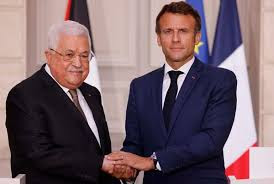


It could very well be that President Macron's obsession with a Palestinian state will be the trigger that could bring about Israeli sovereignty over Judea and Samaria.

The countries of Europe granted the State of Israel very few days of grace after the slaughter of Simchat Torah (Oct. 7th). It was only during the first days, when Israel was really on its knees, battered and broken, that the Europeans were willing to support us. Within a short time, however, with Israel in the midst of bitter, existential battles in Gaza, the same old vile calls began to be heard – about the disproportionate nature of our response, about our obligation to enable our mortal enemies to receive humanitarian aid (including, of course, much non-humanitarian aid], and about the need to end the war, no matter what the future cost to us might be.

Countries such as Spain, France, England and others began speaking of Israel in terms until then reserved only for their biggest enemy: Russia. They declared that they would impose sanctions, they threatened to unilaterally recognize a state of Palestine, and of course they accused us of genocide and other war crimes. If in Israel there remained a small minority of people whose opinions about peace with the Arabs did not change after Oct. 7th, in many parts of Europe the reaction to Oct. 7th was even worse: Many began to take a strong stance against Israel! They managed to find a way to blame Israel even for being slaughtered and for everything that followed, with no need for evidence or proof and relying only on the barefaced lies of Hamas.

Yet from bitter adversity often comes blessing. The hatred directed at us has actually led to the reopening of a very blessed and surprising development: the matter of Israeli sovereignty in Judea and Samaria.

First of all, the arrival of U.S. Ambassador to Israel Mike Huckabee has signaled a welcome change in the US approach to Yesha. If in the past, the State Department forbade its envoys to Israel from setting foot in Yesha, and if even former Ambassador David Friedman had to pay condolence calls to Yesha families not in his official capacity but only as a private person – Huckabee is taking precisely the opposite approach. One of his official welcoming ceremonies took place in none other than ancient Shilo in the Binyamin region of Samaria – one of the sites that express most strongly the Biblical ties between the Jewish People and the Land of Israel.

One would have thought, then, that Israel would have been by now well on its way, with American support, to declaring its sovereignty in Yesha, as originally and long promoted by Women in Green. Yet, in fact, the matter of sovereignty has not even come close to being top priority, neither in Israeli thinking nor in American, because of the many other issues the two countries must deal with together.

And yet now, this might be changing – not because of an Israeli or American decision, but because of something going on now in France, and particularly with its president, Emmanuel Macron. When he's not getting pushed around by his former teacher and current wife, he seems to be busy with shoving of his own: pushing Israel into a corner and forming a Palestinian state.

The PA State June Conference

Macron and his Saudi friends have announced a "June Conference" to be held at the United Nations this month, "aimed at advancing global efforts towards achieving a two-state solution to the Israel-Palestine conflict." Last week Macron brought Great Britain and Canada on board with a joint declaration regarding not only Judea and Samaria, but also Gaza – an artificial and forced conglomeration that, if it succeeds, will only shove peace further away.

So far, so bad – but in truth, it might actually be the harbinger of something very good. Macron has unintentionally restored to the table the historic settlement enterprise of Judea and Samaria, whose status has been limping along for decades. Now, however, due to Macron's efforts, it might actually come under full Israeli sovereignty – finally! How so?

It's very simple: When a foreign country seeks to grant legitimacy to the sworn enemy of another country (Israel, in this case), and grant it a state in Israel's heartland while Israel is still licking its wounds of the Oct. 7th massacre, Israel can simply not stand passively by. It will have to respond with a bold move of its own – and that will likely be a Knesset vote to support sovereignty in Judea and Samaria. This is not just a guess; top Israeli figures, whose names are mentioned below, have made it clear that this is what will happen.

The Yesha Council of Jewish Communities in Judea and Samaria is taking the lead in ensuring that the Israeli response will be, as a first step, a ceremonial Knesset resolution to this effect.

In truth, it shouldn't be much of a big pill for the Israeli public to swallow. One of the many things that all Israelis share is the fear that an Arab mob might invade our communities, just as happened on Simchat Torah. This is the great concern that, for years, drove the residents of the north to demand aggressive action against Lebanon, and it is now what motivates the residents of the Coastal Plain – Raanana, Kfar Saba, and points north, west and south – to push for the strong IDF offensives against the terrorists of Jenin and their neighbors. Israeli sovereignty in Yesha can answer these anxieties in several ways: Yesha will no longer be considered the forgotten backyard of the State of Israel; passivity will be replaced by initiative, especially military; and the country's entire approach will take on a proactive nature rather than defensive.

The Lessons of Judicial Reform

Having learned the lessons of the pre-Oct. 7th attempts to change Israel's judicial system, the Yesha Council is working overtime to make sure that the drive for sovereignty will not take on the same confrontational nature. How can this be done? By returning to the model of "opposition to a Palestinian state." During the course of the current war, the Knesset has already passed declarative resolutions against this dangerous entity – and the most important part of this development was that the votes were bipartisan, coordinated between leading MKs of both the coalition and the opposition.

And this is also why Yesha Council has reached out to enlist MKs Simcha Rotman (of the coalition's Religious Zionism party) and Oded Forer (of the opposition Yisrael Beiteinu party) in a joint effort to sponsor the Knesset resolution for sovereignty. A bipartisan initiative of this type will not lend itself to being brushed aside easily by the anti-Netanyahu forces – but just as importantly, it will help Israel in the international arena. This is because our good friend the United States cannot be more Zionist than Israel! Behind closed doors, the Americans are saying that Israel must first come out strongly against a Palestinian state, and only then can they themselves support that stance! As such, Macron's anti-Israel obsession may turn out to be the first step of the salvation we have been awaiting.

It must be noted that the matter of sovereignty has never been a top priority of Prime Minister Netanyahu. But even he now understands that he cannot ignore a European resolution favoring a Palestinian state. His trusted political ally, Strategic Affairs Minister Ron Dermer, even recently told Administration officials that Israel's immediate response to the Saudi-French initiative will be the application of Israeli sovereignty in Judea and Samaria. Foreign Minister Gideon Saar, too, gave a similar message to the British and French.

Why is the Macron initiative so dangerous? Because it is liable to lead to international sanctions against Israel, such as more wide-ranging embargos on Yesha goods, perhaps a boycott of Israel in international cultural events, and of course a platform for recognition by more and more countries of a dangerous, fictional Palestinian state.

Mr. President Macron, it could very well be that we will end up thanking you for your hatred of us and the welcome decisions it stimulated us to make. 

Thursday, May 29, 2025

Perhaps the Last Chance

by Emmanuel Shiloh, editor of the Besheva weekly, translated by Hillel Fendel.


The current offensive in the war against Hamas – Gideon's Chariots – might be the last chance Israel has to destroy the enemy. 

If the Government of Israel wishes to defeat Hamas, it must conduct this war with the understanding that the window of opportunity to do so is narrowing, if not closing. It is very likely that Gideon's Chariots might very well be our last opportunity for a very long time to win.

Why is this? The international diplomatic pressure upon Israel is intensifying, as is the pressure from within. The extreme-left wing of the anti-government "Free the Captives at Any Price!" protests is becoming even more extreme and unrestrained. It is already now both denouncing Israel as committing war crimes, and promoting refusal to serve in the army during the war. This is in addition to its ongoing campaign for the hostages, which regularly floods public opinion with emotion, disrupts its logical judgment, and aggressively demands that victory be forsaken and our national security be abandoned – all so that the hostages will return, which they feel justifies absolutely any price.

Another hourglass is also running out as well: that of the soldiers, and particularly the reservists, many of whom have served months and months at a time. The burden upon them, and their wives at home, is becoming greater and harder by the day. The percentage of reservists who showed up for duty for this offensive was high, because they sensed that this time it would be serious and that the government would really be going all the way towards victory.

But if it turns out that this is just another round of a never-ending war of attrition, it is highly doubtful that it will be possible to mobilize most of the reservists for another round. Not to mention that the well-oiled campaign to forcibly draft the hareidim "right now" is creating, by design, a feeling among the reservists that they are being taken advantage of, and is decreasing their motivation to fight.

It's not so pleasant to tell the new Chief of Staff, Lt.-Gen. Eyal Zamir, that he only has this one chance to win, after his predecessor was given almost unlimited resources of time. But Zamir knew the situation he was entering, and took on the job with the promise that he would know how to achieve victory under the given circumstances.

It does not look, however, as if the government realizes that this is perhaps its last chance. All signs indicate that even though the army has already begun deploying five divisions, and despite the large-scale call-up of reserves, Israel is still ready to stop on a dime if necessary. If and when Hamas feels that it has absolutely no choice and that Israel is about to deal it a true knock-out punch, it knows that it can quickly declare that it is accepting the Witkoff Outline. This will enable it to receive a 60-day ceasefire and the release of hundreds of terrorists from prison, in return for approximately half of our live hostages.

When such an option is always open to Hamas, why should it ever surrender?

This is a strategic blunder on Israel's part. Most unfortunately, it appears that the objective of both Netanyahu and Chief of Staff Zamir is not to "win," at this point. They are rather seeking to impose military pressure upon Hamas so that we can gain another ten hostages. If a 60-day ceasefire is agreed to, it is far from clear whether we will be allowed to finish the job of destroying Hamas afterwards.

Regarding the hostages, Israel's situation can be likened to a man whose child has been kidnapped by a cruel man holding a gun to the child's head and making a series of impossible demands. The father has the choice of trying to convince, or reprimand, the kidnapper; trying to pull the child away from him; or knocking the gun out of the kidnapper's hand. But the most effective solution is to simply shoot the kidnapper in the head – and the problem will be solved.

In the current situation, Israel should not be trying to drag out the time simply to squeeze out some more hostages at unbearably high prices. Rather, what Israel must do is to deliver a stunning knock-out blow and obliterate Hamas once and for all. The terrorists' hold upon the hostages will thus be weakened, and our captive brethren will return home.

In order to defeat Hamas, we don't have to kill every last terrorist, blow up every single tunnel, or capture or destroy all their weapons. Rather, as history has shown, victory in war can often be achieved when the enemy's "fighting spirit" has been decimated. When Hamas truly realizes that it has absolutely no chance of winning, it will simply quit, no matter what.

The recent elimination, three days before Gideon's Chariots began, of Muhammad Sinwar, as well as of other top Hamas terrorists, was just another in a long line of heavy blows suffered by Hamas at our hands over the past 19 months. Its top military, political, and organizational leadership has been almost completely eliminated, it has lost tens of thousands of fighters, very little remains of its rocket threat, and a significant portion of its weapons and bomb-making facilities have been destroyed or captured. Vast areas of Gaza Strip cities have been reduced to ruins, and two million Gazans have become refugees in their own country, forced to spend their time finding food and shelter.

Why, then, have they not surrendered? How is it that their fighting spirit still survives?

Some claim that because they are Islamist fanatics, they will simply never give up – because at worst, they will die a martyr's death, with all the heavenly delights that they have been promised. But the fact is that this did not hold true for the now all-but-defunct Hizbullah and ISIS, which were just as extremist.

Rather, the answer is very different: The reason that Hamas has not yet given up is because there are elements that support it and provide it with hope that all is not lost, and that if push comes to shove, Israel will be the first to blink. One of the main players giving Hamas this boost is, as mentioned, the campaign for the release of the hostages at any cost.

The international pressure that takes on varying shapes and forms is also a source of great hope for Hamas that it will manage to finish this war while still standing on its feet. And within Israel, those seeking to topple the Netanyahu government, or to draft the hareidim, or to support refusal to serve in the IDF, all signal to Hamas, "Not all is lost! Netanyahu will soon be off the stage! Hold on just a bit longer!"

In order to break the spirit of Hamas, it must be stopped from receiving support and reinforcement from these elements. It must be clear to Hamas that nothing will stop Israel from destroying it.

In order to win, if this is still possible, Netanyahu and Zamir have to stop trying to reach another temporary deal with Hamas, even for the exchange of some hostages. They must go full-force in the current military campaign – as if this was their last chance, which it probably is. No further rounds of fighting can be expected after this one.

Yes, this risks the hostages' lives to a certain extent – but the time has long come to stand by the ethical equation that says that our soldiers' blood is no less red than that of the hostages. We cannot fight an eternal war of attrition that continues to cost us in young soldiers' lives. The hostage situation is a catastrophe – but so is an end to the current war without victory, which will cost us in hundreds of lives, if not thousands, in the future.

Our objective now must be total conquest of the Gaza Strip within a short number of weeks; the establishment of a military regime there in place of Hamas; and allowing hundreds of thousands of Gazan Arabs to leave for other countries if they wish. When this happens, we will be able to finally declare victory, and the hostages will return home.

If the government and the IDF do not head this way in full force, we will have to assume that Netanyahu and Zamir do not really want victory.

Thursday, May 22, 2025

Time to Wean Ourselves From Oslo – Sovereignty Now!

by Omer Rachamim, Director-General of the Yesha Council of Jewish Communities in Judea and Samaria, translated by Hillel Fendel.


Catching murderous terrorists cannot be our ultimate objective. Uprooting terrorism must be.

Prime Minister Netanyahu's announcement to the press last night – just after the terrorist murder of Tze'ala Gez in the Shomron as she was on her way, with her husband, to give birth to their 4th child – tells the whole story.

This is what he wrote: "I trust that the security forces, in this case as well, will quickly get to the murderers and bring them, and all who aided them, to justice."

What's wrong with that announcement? Don't we want the long arm of our security network to pursue, catch, and kill if possible the vile murderers, as they general do so effectively and quickly?

Of course. But as we so often see, such actions simply do not prevent the next terrorist attack.

So what then must we do?

1. A significant and damaging blow must be dealt to the entire expanse in which the murderer lives. We need not waste time on chasing and finding him; his village must rather be destroyed. The entire space in which he lives and walks around and breathes is all about terrorism – from the graffiti on the walls, through the schools that teach the glories and importance of terrorism, and to the mosques in which terrorism is preached and prayed for. All of these, and more, must be systematically dismantled and destroyed.

How is this to be done? It's very straightforward: The populace must be given notice that they must evacuate within x amount of hours, or else face the consequences. Instead of awakening in their beds the next morning, the residents of the Arab villages of Burakin and A-Dik should have been exiled from their homes and woken up the next morning in tents, just like their brethren in Gaza.

Sounds too extreme? Speak to Col. Avichai Edrei, the IDF Spokesman in Arabic. His Twitter account is about to explode from the many "Evacuate Now!" announcements he has issued. Just as these worked quite well in Gaza, they will work perfectly well in Judea and Samaria as well.

2. The concept of "maintaining the fabric of life for the general populace" must disappear, once and for all. This laundered and inadequate phrase paves the way for nothing more nor less than placing the very lives of hundreds of thousands of Jewish residents of Yesha on the line every time they take a drive. Terrorists are simply not afraid to shoot at them, nor is it a difficult mission to do so.

It's unbelievably insane how easy it is for the same Arabs who are not permitted to enter Raanana or Afula to wait in traffic jam alongside residents of Maaleh Adumim, or to get within spitting distance of the homes of residents of Ariel.

It should be that Israeli citizens use a network of comfortable and safe roads, while the Arabs of Judea and Samaria use a separate system. What's amazing is that these networks already exist. 

In addition, the roadblocks and checkpoints must return as a regular feature to the lives of the Arabs in Yesha. For them to be able to travel freely means they can easily escape from place to place without being caught or even stopped.

3. When a terrorist attack occurs or is attempted, the punishment must match not the results, but the intent. If there happen not to be any dead Israelis as a result of a given attack, this does not mean that the terrorist infrastructure responsible for the attempt should not be dismantled. For instance, in the case of the most recent murder, three similar attacks took place in the same area; thank G-d, none of them ended with dead Jews. But the Israeli reactions to these attempted murders were on a minor scale – leading directly, apparently, to the horrific murder of a young mother on her way to give birth.

4. Military actions are important, but they are not the primary element; our diplomatic actions are much more critical. Unlike what the left-wing camp claims, terrorism is not based on "despair," but rather on "hope." The terrorists continue to hope that they will be able to rid us from our land – not just from Yesha, but from Haifa, Acre, Jaffa, the Coastal Plane, and everywhere else.

There is only one way to cut down this hope – and that is by instituting Israeli sovereignty in Judea and Samaria. When we delay and hesitate, as we have been doing for several years on this issue, we are actually telling the Arab enemy that they can realistically continue to "hope" that we will not be here forever – and that terrorism can only help their cause. When we vacillate, we are saying that we have not yet really decided that we are here to say. The time is long past due to make it eminently clear: "We're not going anywhere."

So why are these steps not being taken? There is one answer: Oslo. Most unfortunately for all of us, Israel's security establishment is still addicted to the "Oslo drug" – and refuses all treatment to help de-program and de-tox itself.

The "Oslo drug" causes dangerous hallucinations, in which Israeli security cooperation with a terrorist entity known as the PA's "security apparatus" is seen as having security value.

If we would rid ourselves of the Oslo conception, enabling a positive "fabric of life" for the Arabs in Yesha would be seen not as a goal in and of itself, but as a tool we must use in order to decrease terrorism. If we do not take this approach, but instead continue to make believe that superficial quiet for a few weeks at a time is genuine quiet – it explodes in our faces.

Mr. Prime Minister, and the other Cabinet ministers: Catching terrorists is important. But changing our conceptions is much more so. The Oslo Accords were, and are, a catastrophe. It's time we wean ourselves, cancel them, and declare sovereignty. 

Wednesday, May 14, 2025

40 Years Since the Jibril Exchange

by Haggai Huberman, Israeli journalist and author, translated by Hillel Fendel.


The return of the corpse of Tzvi Feldman, of the 1982 Battle of Sultan Yaaqub, reminds us of the 1982 Peace for Galilee War – and the fateful decisions that followed it (1150 Freed Terrorists Led Directly to the First Intifada, the Founding of Hamas, and Untold Numbers of Deaths), and the critical importance of Jewish settlement.

The happy news of the return of the remains of IDF soldier Tzvi Feldman, captured alive during a horrific 1982 battle with Syria that felled 33 soldiers, occurs very close to two important and historic anniversaries: Israel's withdrawal from Lebanon in May 2000, and the Jibril Deal in May 1985, in which 1,150 terrorists were released in exchange for three captured Israeli soldiers.

Feldman was killed, apparently, shortly after his capture during the First Lebanon War, also known as the Peace for Galilee War. This was a war that began with fairly broad national consensus, in response to ongoing Lebanon-based PLO attacks against Israel, including rocket fire, bombings, and infiltrations. However, as the war dragged on and its strategic goals became vaguer, Israel's government and military began to lose public confidence – and in fact, within a year-plus, both then-Prime Minister Menachem Begin and then-Defense Minister Ariel Sharon were out of their jobs.

This war was the first face-to-face clash between Israel and the PLO. One of the indirect objectives of Operation Peace for Galilee was to mortally strike the PLO, headed by Yasser Arafat, so as to strengthen Israel's hold in Judea and Samaria, where the PLO sought Arab Palestinian sovereignty.

According to one school of thought, Sharon believed in an even more far-reaching scenario: After a friendly Christian Maronite government would be formed in Lebanon, headed by Bashir Jumayel, the Maronites would get the Arab Palestinians in southern Lebanon to leave for Jordan – and this would hopefully lead to a Palestinian state in Jordan. This would neutralize the primary objection to Israel's presence in Judea and Samaria, which was that the Palestinians had become a "people without a state."

In the early stages of the war, this plan seemed to be on the way to working out. The PLO was expelled to far-off Tunisia, and Israel's friend Jumayel was elected President of Lebanon. But then two things happened that changed the course of history.

In September 1982, before Jumayel could even take office, he was murdered by Syrian elements, thus throwing the entire plan off-course. Ten days earlier, something even more significant happened, the grave consequences of which no one could foresee: Eight Nachal Brigade soldiers were captured in southern Lebanon. Six of them were released in November, in a relatively minor exchange (mostly for prisoners held in a Lebanese jail).

But then came one of the State of Israel's worst decisions ever: the agreement to release 1,150 terrorists in exchange for the two remaining captive soldiers and one other, who were all being held by Ahmed Jibril's PFLP terrorist organization. The third captive soldier was Chezi Shai, who had been captured during the Sultan Yaaqub battle; three soldiers were declared missing from that battle, including Zechariah Baumel, whose corpse was brought to Israel for burial in 2019, Tzvi Feldman, mentioned above, and Yehuda Katz, not yet located and still awaiting burial in Israel. May G-d avenge their blood.

I still remember the festivities in Gaza when the terrorists were freed. I lived then in Netzarim – which was evacuated in the 2005 Disengagement Plan – and the celebrations could be heard in our home. They certainly had what to celebrate about, not only in terms of the quantity of terrorists, but also their "quality." The freed murderers included such names as Kozo Okamoto (a Japanese Red Army member involved in the 1972 Lod Airport Massacre in which 26 people were murdered); Sheikh Ahmed Yassin, released after two years of a 13-year sentence, who later founded and became the spiritual leader of Hamas; Jibril Rajoub (not to be confused with Ahmed Jibril), sentenced to life imprisonment; and numerous others, including many of those who later instigated and led the First Intifada beginning in December 1987.

The front page of the next day's edition of Yediot Acharonot featured a large photo of the ultimate Palestinian terrorist victory scene: released murderers Suleiman al-Zaki and Ziyad abu-Ayn holding up their hands showing V-for-victory. It is another such photo like this, giving great motivation to the PA in its bid to destroy Israel, that we seek to avoid today.

Let us note another sad anniversary: This week marks 45 years since the grave Palestinian terrorist murder of six young Jewish men near Beit Hadassah in Hevron, on the first Sabbath night of May 1980. One of the murderers is now serving as the mayor of Hebron, having been released in the notorious Jibril Deal.

An internal Shabak investigation found that close to two-thirds of the Jibril Deal-released terrorists (as well as the 435 who were freed in the 2004 Tenenbaum deal) returned to active terrorism. The release of three Israeli soldiers thus ultimately led to the loss of hundreds of Israeli lives.

The Compounded Mistake

At the time of the Jibril Deal, it was proposed to then-Defense Minister Yitzchak Rabin to at least expel the released terrorists. But Rabin felt that keeping them in Yesha (Judea and Samaria, as well as Gaza in those days) would enable Israel to keep a tighter watch over them. However, within 27 months, he was proven deathly wrong, when many of these very terrorists helped instigate the Intifada. And it was that which led to the ill-fated Oslo accords, the establishment of the Palestinian Authority, the withdrawal from most of Hebron, and hundreds of Israeli deaths.

In the words of Zev Shiff and Ehud Yaari, in their book "Intifada:"

"There is no longer any doubt that the freed terrorists of the Jibril Deal played a central role in the intifada. According to authoritative estimates, within just a year of their release, more than a third of them had renewed their subversive activity in one way or another. Most of the rest [then] went into activity almost immediately, with the outbreak of the first wave of rioting… Jibril would later take pride, justifiably [from his standpoint - HF], that this operation planted the seeds of the uprising." That is, within just over two years, the Jibril Deal was the gasoline that fueled the engine of the intifada.

The first intifada was that which created a nearly irreversible situation in Yesha: The People of Israel, in large numbers, stayed away from parts of the Land of Israel. Those who didn’t live there, just didn’t come. They became too afraid, and distanced themselves from their Biblical homeland of Judea and Samaria: the golden wheat fields of the Dotan Valley, the ruins of the biblical city of Samaria (Sebastia), the beautiful Umm Tzafa Forest in the Binyamin region, the majestic Herodion archaeological site, and the Tomb of the Patriarchs (Machpelah Cave) in Hevron.

Judea and Samaria became the "Land of the Setters," and hardly anyone other than them (certainly not delivery drivers!) came to see it.

This then led to a sense of estrangement from these areas, which paved the way for a willingness to give them away in some kind of political agreement. The result: the calamitous Oslo Accords of the 1990's, which removed large areas of Yesha from Israeli control – precisely the opposite of the original goals of the 1982 Lebanon War, as explained above.

If at least the freed terrorists of 1985 had been expelled, it is likely that the tragic consequences of these events could have been avoided.

Only one thing stopped the stains of retreat and withdrawal that spread out over the map of Yesha: the Jewish settlement enterprise.

Friday, May 9, 2025

Greener on the Other Side? Not So Sure

by Zev Kam, tour guide, journalist, and frequent commentator on Kan Public Israel Radio, translated by Hillel Fendel.


A Light, Encouraging View From the Lebanese Front

In the summer of 2021, less than four years ago, the soldiers of Battalion 221 of the IDF's Carmeli Brigade were on reserves duty, with the routine mission of holding a line on the Lebanese border. The troops were stationed at the time on the western side of the border line – precisely as they are now, during these five months since the ceasefire with Hizbullah/Lebanon. Aside from the location, there is nothing else of the two periods and the two stints of duty that are comparable.

Then, four years ago, what frustrated the soldiers no end, and what was their lot throughout their tour of service, was the fact that they could see Hizbullah terrorists just beyond the fence – and there was nothing they could do. The terrorists would stand with cameras and photograph the soldiers' faces, curse them, hold up middle fingers – and the soldiers' hands were tied; they could not respond.

The terrorists even built structures right on the border, from which they could peer directly into Israel – and our soldiers, again, were helpless. It was some kind of "decree of destiny" imposed by an army and its leaders that had simply become accustomed to having the enemy mock them, learn their actions and schedules, and even erect a tent within Israeli territory (!), full of weapons. And our soldiers were totally unable, by order, to do anything.

This time, now, everything is different. Every battalion soldier on reserves duty this time is experiencing something totally different – 180 degrees different. Their two and a half months on the border are ending these very days, and what they will tell you is that, first of all, there's no Hizbullah on the border. Not even one terrorist. The troops patrol the border, and even often enter Lebanese territory, and there's no trace of terrorists. The IDF is systematically enforcing the ceasefire agreement, and does not allow a thing to happen that violates it. In the world of psychology, they would say that this is a "corrective experience," helping to heal and counteract the effects of what happened back in past years – not only for the soldiers who served there, but for the long-suffering residents of northern Israel.

It's not that the enemy or its weapons no longer exist. But they are scared and they're hiding – far away from our border. Instead of mocking our soldiers, they worry now only that they will be killed. And the numbers support their fears: Ever since the ceasefire came into effect last November, the IDF has killed 140 terrorists who were about to violate the truce, violently or otherwise.

This is also not to say that Hizbullah is not trying to rebuild itself, as close to Israel as possible. They can't build real buildings, so they bring in mobile structures – caravans, or mobile homes without wheels, to try to revive the former terrorist stronghold villages. But when they do so, an Israeli drone promptly comes along and bombs it. In the town of A-Nakura, for instance, there has been barely a week when the new caravans they brought in were not destroyed. And the story was the same elsewhere as well, until finally, Hizbullah stopped bringing in caravans.

One of the more memorable aspects of the warfare with Hizbullah is the story of the "nature reserves." They're not quite reserves, but they have enough shrubbery and overgrowth that the terrorists used to be able to take cover there and even fire at the IDF forces. One day, at the beginning of the current war, some Israeli reservists actually built a Roman-style catapult and fired over some fire-torches to burn large swathes of the greenery. Of late, the IDF has continued to deal successfully with this problem, clearing very large areas in Lebanon, particularly in the areas within hundreds of meters from the Israeli border, to prevent the enemy from coming near us under the cover of green.

But of course nature continues to run its course, and the growth does what it knows how to do best: it grows. The forces tried spraying various growth-retardant chemicals, but these too were insufficient. So the soldiers of Battalion 221 became gardeners: They set out for Lebanon to trim or cut down trees, cut off branches, and basically clear entire areas practically by hand. They marched through the wadis of southern Lebanon, equipped with state-of-the-art gardening tools – thus proving that it is actually not true that the grass is always greener on the other side…  

And here's another thing that is worthwhile to know: In all the Lebanese terrorist-stronghold villages along Israel's borders that the IDF destroyed in last year's war, not one of them has begun to be rebuilt. Not one. They are simply not settled; desolate. Here and there people are seen coming to collect some of their belongings or metals for one purpose or another – but no one lives there.

In Israel, on the other hand, the residents of almost every single northern village have returned home.

No one is saying that everything is hunky-dory or that there's nothing to fear. In the town of Shlomi, for instance – a beautiful Israeli village in the northwestern Galilee, population 8,000 – they built a new school about two years ago. But then the war broke out, the town came under Hizbullah fire, and people left. Now that they have returned, the question was raised: "What do we do with the new school? After all, it's even closer to the border than the old school was!" Some parents, and teachers, were quite jittery at the prospect of holding classes there.

The security officer of Shlomi quickly called the commander of Battalion 221, Brig.-Gen. Binyamin Tropper, and asked him to explain the situation to the concerned residents. Tropper came, explained to them how the situation had been reversed, told them how many soldiers are holding the area, and provided encouraging details regarding the new circumstances.

Almost everyone was reassured – except for one teacher, who asked, "Why is the soccer field in town still not lit up? And the same for the streetlights in that neighborhood. Doesn't that mean that we're still afraid that Hizbullah will fire rockets at us?"

The mayor, who was also present, was puzzled, and asked that the matter be checked. Within minutes, it turned out that no one had turned off the lights at all. Rather, a Hizbullah rocket a while back had knocked out part of the electricity in the neighborhood – and no one paid much attention to it - probably because no one was living there for a while, having all been evacuated to "southern" Israel. The matter was quickly resolved.

This story shows that there are still fears, and no one should make light of them. But the new school in Shlomi is now open.

And for a final incident, this one a bit more amusing: Overlooking Shlomi is an IDF outpost named Magen Yehuda (Shield of Judah), the largest of five such points inside Lebanon. Though they are well-protected, they are not only for the purposes of defense. Not a day goes by that the IDF does not send forces relatively deep into Lebanese territory to search for weapons and the like left behind by Hizbullah, and in general to safeguard the area.

Every move that the Lebanese Army, or the UN forces adjacent to the border, wants to make must be closely coordinated with the IDF – and in fact this is the case most of the time. On the other hand, the IDF doesn't coordinate with anyone when it wants or needs to enter Lebanon. Whenever the security needs of the residents of the north require it, even indirectly, the troops enter Lebanon and do what has to be done. This led to an interesting ping-pong exchange with the Lebanese Army recently.

What happened was that the IDF brass decided that the buffer zone around Magen Yehuda needed to be expanded, so as to ensure that the terrorists do not try to come close. And so, one night the Israeli troops went out with metal posts, known as baznatim, and stuck them in the ground some distance away from Magen Yehuda, in order to show the locals that there was a new "border." The next morning, the Israeli cameras showed a lot of confusion. The Lebanese locals seemed to not understand what had happened while they were sleeping. Still, however, after a few days, they decided to show some muscle, and went to remove the baznatim.

For the Israelis, this was not the end of the story, but rather only the beginning. They sent another force in that very night to replace the baznatim. But the Lebanese, too, didn't give up – and thus began a ritual of them removing, and our side replacing.

Until finally one time, when the Lebanese soldiers came to uproot the baznatim, they found themselves with hands full of oil and grease – which the Israelis had spread over the posts before leaving them in the ground. This time the cameras caught the Lebanese gesticulating in frustration at the tremendous mess they had made of themselves, and at the prospect of the long showers they would have to take – if there were any in their outposts.

Yet another time, when the Lebanese tried to uproot the metal posts, all of a sudden, miraculously, light bombs exploded from within – totally harmless, but frightening just the same. Their cries of shock could be heard all the way to the new school in Shlomi - where the pupils are safely attending classes.